The importance of Emergency Medical Services (EMS) is increasing day by day, becoming a fundamental pillar in the health care system that contributes to preserving the health and well-being of individuals, families, and communities. The growing demand to improve the quality of care in critical cases and disasters has reinforced the development of ambulance methodologies and evidence-based care practices. This advancement has also necessitated the provisioning of professionally and training-qualified personnel capable of field diagnosis, rapid decision-making, and delivery of emergency medical care according to the highest standards of safety and quality.
The Emergency Medical Services Department offers a Bachelor’s program in Emergency Medical Services, designed to transfer knowledge and develop professional skills to achieve a high level of competence in the field of EMS. The department is equipped with specialized laboratories containing clinical devices and equipment that enable students to practice realistic simulated emergency scenarios, such as: obstetric and pediatric emergencies, cardiac emergencies and airway and breathing management, multiple-incident accidents and injuries, and basic medical care. These activities enhance students’ skills and their ability to perform their expected role in society as part of the health care team.
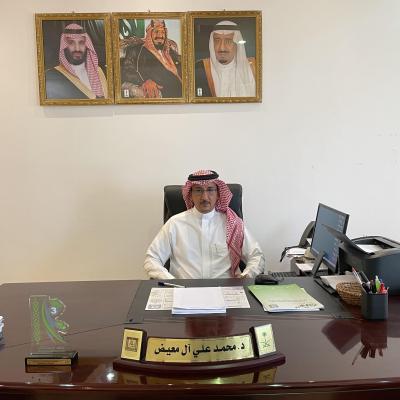
Dr. Muhammad Moeed Asiri began his educational journey at the Health Institute for Boys in Abha, where he earned a diploma in pharmacy. In 1414 (the corresponding year in the Gregorian calendar being 1994), he enrolled in the College of Health Sciences in Abha, graduated, and subsequently became a trainer at the college. He dedicated ten years to working in the training field. During this time, he was given the opportunity to further his studies and was sent to the UK to pursue a master’s degree, which he completed in 2010. He was later sent to Australia to obtain a doctorate, earning it in 2018. After this extensive period of hard work and study, he returned to the college, where he was appointed as the Head of the Allied Medical Sciences Department.
Mission:
To prepare academically distinguished graduates who are scientifically and professionally specialized in the field of Emergency Medical Services, possessing knowledge, skills, and Islamic values that serve the community, align with quality standards, and meet the requirements of the labor market; while utilizing scientific research in the specialization and applying it effectively at the national level.
General Program Objective:
The Emergency Medical Services program aims to prepare graduates who possess the knowledge, understanding, and practical skills that qualify them to work as trained paramedics in various work settings where people require emergency medical care, thereby meeting their health needs in any region of the Kingdom of Saudi Arabia.
Strategies to Achieve the Mission
- Promote a modern teaching environment and educational program.
- Enhance the quality of the department and its members.
- Strengthen learning projects.
- Establish linkages with the service and clinical sectors.
- Communicate with similar organizations and departments at the national and global levels.
- Promote the highest ethical and professional standards.
Learning Outcomes for the Emergency Medical Services Program
- Possess comprehensive, coherent, and systematic knowledge in the field of Emergency Medical Services, including the latest developments, regulations, technical requirements, and related hypotheses.
- Apply research principles and educational emergency services concepts to interpret literature, advocate for evidence-based practice, and support continuous professional and educational development.
- Integrate principles of pathophysiology and outcome assessment to formulate a diagnostic impression of the patient’s condition and implement a treatment plan during the delivery of emergency medical services.
- Integrate principles and processes of medical emergency services in large-scale gatherings and multi-injury disaster situations to function effectively as an emergency medical services professional.
- Demonstrate proficiency in leadership and management, and the ability to work collaboratively with multidisciplinary medical teams, while adhering to professional ethics.
- Participate in public health promotion to reduce disease and injury by applying basic principles of public health knowledge.
- Practice emergency medical services independently within the boundaries of the ethical and legal scope of practice.
- Demonstrate communication skills in group settings, conveying and interpreting information and ideas to achieve effective performance in patient care and transportation.
Graduate Attributes
- Participate in building teamwork and professional relationships with health care teams.
- Demonstrate self-reliance and develop administrative and future leadership skills in the work environment.
- Show respect, team spirit, and commitment to serving the community with high professionalism.
- Preserve Islamic values, good character, and professional ethics.
- Be able to adapt to different health care environments inside and outside the Kingdom.
Laboratory for Obstetric, Pediatric, and Women’s Emergencies:
This laboratory focuses on training students to assess and manage emergency cases related to pregnant women, childbirth, and children, including monitoring vital signs, managing hemorrhage, handling complex delivery situations, and providing primary care for children in critical conditions. Realistic simulation models and medical monitoring devices are used to train students to make rapid clinical decisions in an environment that closely resembles actual clinical practice.
Laboratory for Cardiac Emergencies and Airway and Breathing Management:
This laboratory serves as the core environment for training students in life-saving interventions for cardiac emergencies, airway management, and respiratory support, including performing cardiopulmonary resuscitation (CPR), using resuscitation devices, and managing the airway in critical cases. Students are trained to read and interpret cardiac electrical signals, use monitoring equipment, and perform interventional procedures under the direct supervision of faculty members.
Laboratory for Accidents and Injuries:
This laboratory is dedicated to training students in managing injuries resulting from accidents, disasters, and multiple-organ injuries, including patient assessment, injury triage, and the management of serious injuries according to field triage standards. Students are trained in techniques for stabilizing injuries, transporting patients, and collaborating with multidisciplinary teams in simulated accident and disaster scenarios.
Laboratory for Basic Emergency Care:
This laboratory provides training opportunities in basic medical care, including general patient assessment, vital signs measurement, management of minor conditions, and performance of first aid. Students are trained in effective communication skills with patients, documentation of health data, and working as part of a health care team in a semi-realistic clinical environment.
- Plans, Curricula and Quality Committee
- Schedules and Examinations Committee
Specific Specialty | General Specialty | Academic Rank | Nationality | Name | |
Nasaalshahrani@kku.edu.sa | Cardiovascular & Respiratory Emergencies | Emergency Medical Services | Assistant Professor | Saudi | Dr. Nasser Saeed Alshahrani |
Taaali@kku.edu.sa | Trauma Emergencies | Emergency Medical Services | Associate Professor | Indian | Dr. Talaat Ali Shawkat |
Bmugaiahgari@kku.edu.sa | Pediatric & Obstetric Emergencies | Emergency Medical Services | Assistant Professor | Indian | Dr. Bharath Kumar Mugaiahgari |
Ttrja@kku.edu.sa | Neuroscience Emergencies | Emergency Medical Services | Lecturer | Saudi | Mr. Talal Talq Al-Shalawi |
ibraghamdi@kku.edu.sa | Trauma Emergencies | Emergency Medical Services | Lecturer | Saudi | Mr. Ibrahim Mohammad Al-Ghamdi |
Ahmedmoh@kku.edu.sa | Critical Care | Emergency Medical Services | Lecturer | Saudi | Mr. Ahmed Mohammad Al-Shdidi |
B.alharbi@kku.edu.sa | Critical Care | Emergency Medical Services | Lecturer | Saudi | Mr. Badr Abdullah Al-Harbi |
Malotaibi@kku.edu.sa | Trauma Emergencies | Emergency Medical Services | Teaching Assistant | Saudi | Mr. Monther Ziyad Alotaibi |
Akheimi@kku.edu.sa | Disaster and Crisis Management | Emergency Medical Services | Teaching Assistant | Saudi | Mr. Abdulaziz Mustafa Kheim |